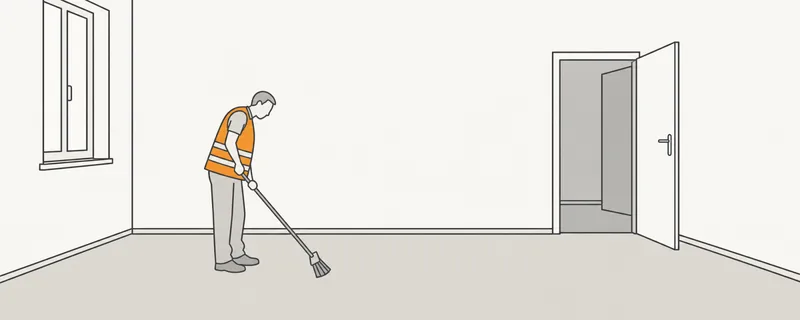
“Return swept clean” appears in many clearance quotations. The term does not appear in Swiss tenancy law. What is required is different and, in practice, more extensive.
Under the Swiss Code of Obligations (OR), the property must be returned in the condition resulting from contractual use. This does not mean as new. Simply sweeping the floor is not enough either.
For an estate clearance, this distinction determines the amount of work and therefore the cost.
What is actually required
The property must be completely cleared. Anything that is not part of the rented property must be removed: furniture, rugs, shelves you installed, lamps or light fittings, with the bulb holder left in place or replaced, curtains and curtain rails if you fitted them. This also applies to the cellar, loft storage, garage, bicycle room, garden shed and balcony.
The property needs a thorough end-of-tenancy clean: windows cleaned inside and out, including frames and shutters, oven and extractor hood degreased, fridge defrosted and cleaned, bathroom fittings descaled, drains clear, cupboards wiped inside, and ventilation grilles, door rebates and skirting boards cleaned. At handovers in the Canton of Zurich, the oven, extractor-hood filter and shutters are the three most frequent points of complaint.
Unauthorised alterations must be reversed. If walls have been added, openings made, fittings replaced or a dishwasher installed, the original condition must be restored unless the landlord consented or wishes to retain the alteration.
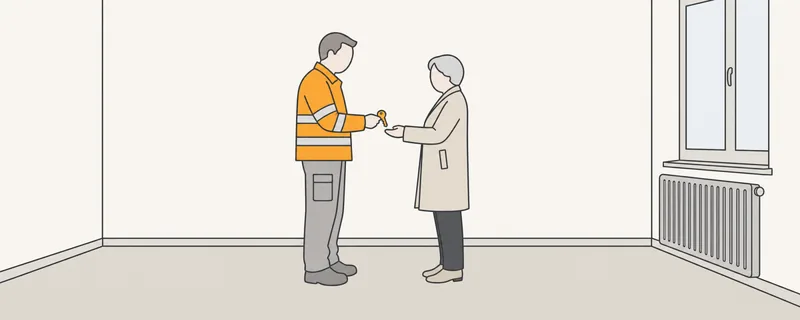
All keys must be returned, including copies you had made. If a key belonging to a master-key system is missing, you may owe the cost of replacing the entire system. Four-figure costs are not uncommon.
What you do not have to pay for
Many heirs pay unnecessarily here.
Normal wear and tear is covered by the rent. This includes:
- Small wall-plug and nail holes in a usual number
- Wear on parquet and linoleum from normal foot traffic
- Walls yellowed after several years of occupation
- Limescale marks on fittings, provided they are not due to neglect
- Wear to carpets and floor coverings along normal walking routes
- Discolouration of kitchen cabinet fronts caused by light exposure
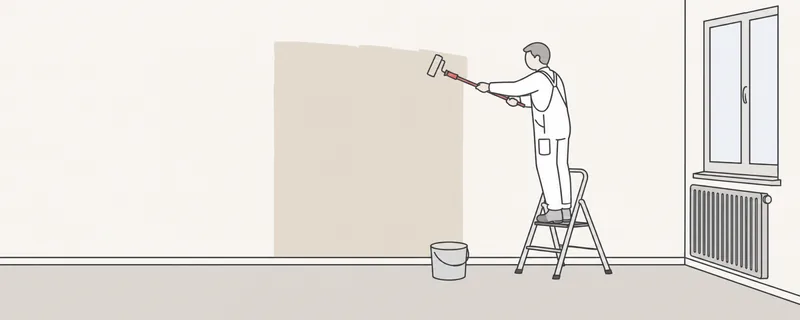
A depreciation calculation also applies to fixtures and fittings. Each part of a property has an average service life: around eight years for wall paint, ten for carpets, and considerably longer for fitted kitchens. Once the service life has expired, the residual value is zero. You then owe nothing, even if the item is damaged.
If only part of the service life has elapsed, you owe the proportionate current value. Example: wall paint with a service life of ten years is six years old and must be renewed because of smoke damage. Four tenths of the cost is owed.
The applicable figures are set out in the jointly agreed service-life table, published by tenants’ and landlords’ associations together. It is not a legal rule, but courts rely on it. For every charge, ask how old the item in question is. In many cases no answer is provided, and the claim falls away.
Reporting defects
The landlord must inspect the condition of the property when it is returned and report visible defects immediately. If the landlord fails to do so, the property is deemed to have been returned in accordance with the tenancy agreement, and the claim falls away.
For the handover:
- Always attend the handover. If you send the key by post, you cannot object immediately and give the other party more room for manoeuvre.
- Read the report carefully before signing it. If you disagree with an item, sign it with the note “noted”, without adding “accepted”. Record your objections directly in the report.
- Take dated photographs of the cleared and cleaned property. This takes five minutes and can be decisive in a dispute.
- Do not sign a blank report. A report without a list of defects that is completed later is of no value to you.
The landlord must report hidden defects, such as water damage behind a cupboard, immediately after discovering them. If the report is late, it is worth raising an objection.
Cleaning it yourself or hiring professionals
For an estate clearance, there are three reasons to hire professionals:
The first is the result. An experienced team knows the points checked by the property manager: the oven, grouting, shutters, fittings and cupboard interiors. These are where complaints arise when properties have been cleaned by the occupants.
The second is time. A professional team needs six to ten hours for the thorough end-of-tenancy cleaning of a 3.5-room property. Working alone and without experience, two full days is realistic.
The third is distance. Cleaning the home of a deceased parent is more difficult for many relatives than they expect. This strain is not mentioned in quotations.
The order is: clear first, then clean, then complete the handover. Cleaning before clearance creates unnecessary costs. There should be no more than two or three days between cleaning and handover, as otherwise dust will settle again.
How we handle it
As standard, we hand over properties cleared and swept clean. End-of-tenancy cleaning is listed separately in the quotation. You can see the cost and choose not to include it.
On request, we attend the handover with you. This is useful if you do not live in the region or are unfamiliar with the process. We know the usual complaints and which of them are justified.
We do not hand over properties in a condition that requires the landlord to clean again and leaves the heirs with the bill. For us, a clearance is not complete if a complaint follows.
Quick check before the handover
- All rooms empty, including cellar, loft storage, garage and balcony
- Curtain rails and lamps: removed or agreed to be left in place
- Oven, extractor-hood filter and fridge cleaned
- Windows inside and out, including frames and shutters
- Bathroom fittings descaled and drains clear
- Wall-plug holes filled if unusually numerous
- All keys and access badges collected and counted
- Meter readings recorded and electricity account closed
- Photographs taken of the final condition
- Service-life table ready for the handover discussion
General information on Swiss tenancy law, not legal advice. If there is disagreement about the handover, the conciliation authority for rental and lease matters (Schlichtungsbehörde in Miet- und Pachtsachen) is responsible. The procedure is generally free of charge.
Common questions on this topic
Must I have the property repainted before returning it?
What happens if the landlord reports defects later?
Your question is not here? Call us: 076 606 22 83.