When a flat is handed back after a death, property managers often give the heirs a list: repaint the walls, replace the carpet, refurbish the oven, fill wall-plug holes. The heirs barely know the flat, have little time and sign. This often costs several thousand francs that the law does not require.
The flat must reflect use in accordance with the tenancy agreement
The tenant must return the flat in the condition resulting from use in accordance with the tenancy agreement (Art. 267 para. 1 of the Swiss Code of Obligations, OR). After a death, this obligation passes to the heirs because the tenancy agreement transfers to them. What is required is an empty, clean flat showing the traces of ordinary living, neither a flat in new condition nor a renovated one.
The law protects this rule: agreements under which the tenant commits in advance to compensation covering more than actual damage are void (Art. 267 para. 2 OR). A tenancy clause requiring the flat to be freshly painted on return therefore usually does not help the landlord.
Normal wear is the landlord’s responsibility
The landlord must keep the flat fit for use during the tenancy (Art. 256 para. 1 OR). Maintenance is covered by the rent. Normal wear is therefore not the tenant’s responsibility. This includes:
- a usual number of wall-plug holes
- worn paths on parquet flooring or carpets
- yellowed or slightly soiled walls after several years
- small scratches on doors and kitchen cabinet fronts
- faded flooring near the windows
After twenty or thirty years in the same flat, almost everything falls under normal wear. Such long tenancies are common among older people who have died.
Excessive wear exists where damage goes beyond use in accordance with the tenancy agreement: a burn mark in the carpet, parquet scratched by a dog, a wall painted dark red, or severe nicotine staining. The tenant, and after the tenant’s death the heirs, is liable for this, but not at the replacement price.
The service-life table limits every claim
For damage beyond normal wear, the tenant owes only the current value. Every part of a flat has an average service life, after which it is fully depreciated. The benchmark is the jointly agreed service-life table, published by the tenants’ association and the homeowners’ association together with other organisations. It is not law, but conciliation authorities and courts use it.
The calculation is: repair cost multiplied by the remaining service life, divided by the total service life. For example, the table assigns a service life of around ten years to wall paint and carpets. The paintwork is seven years old and must be renewed because of nicotine staining. The decorator’s invoice is CHF 3’200. Three tenths is payable, which is CHF 960. If the paintwork is twelve years old, its residual value is zero. The heirs then owe nothing, even if the wall is yellow.
Ask for the age of every item for which payment is claimed. The property manager knows the date of the last renovation. If no answer is provided, the claim is not supported by evidence.
Repainting is not required
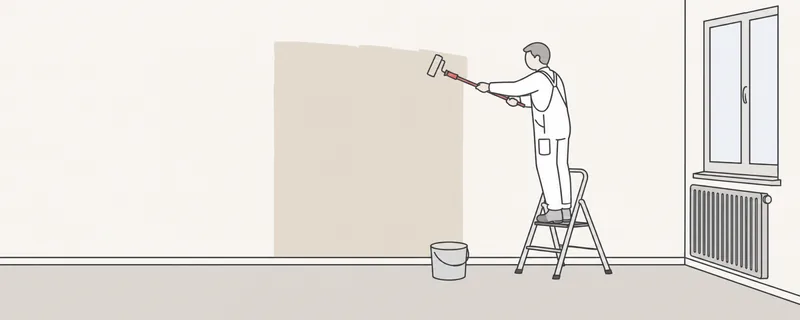
The most common demand made of heirs is to repaint the entire flat. This is not required where the walls show normal wear. If there is damage and the paintwork’s service life has not yet expired, a proportional amount is owed. The full amount is owed only if the tenant painted the walls in a colour that makes reletting more difficult and the paintwork is still new.
The same applies to flooring and kitchens. If a kitchen is older than the service life shown in the table, the landlord replaces it at their own expense.
Minor maintenance remains the tenant’s responsibility
The tenant is responsible for minor cleaning and repairs that form part of ordinary maintenance (Art. 259 OR). In practice, these are tasks that a person of average practical ability can perform without specialist knowledge and with little effort: replacing extractor filters, changing fridge seals, clearing blocked drains, filling wall-plug holes, and replacing light bulbs. The precise boundary depends on the individual case.
When clearing a flat after a death, it is worth completing these small jobs before the handover or including them in the clearance quotation. Otherwise, the property manager will charge for them at tradespeople’s rates.
Handover report and notice of defects
The landlord must inspect the flat when it is returned and immediately report defects for which the tenant is responsible (Art. 267a para. 1 OR). If the landlord fails to do this, any claims are lost (para. 2), except for defects that could not be detected during the inspection (para. 3). Hidden defects must be reported immediately after discovery.
For the heirs, this means:
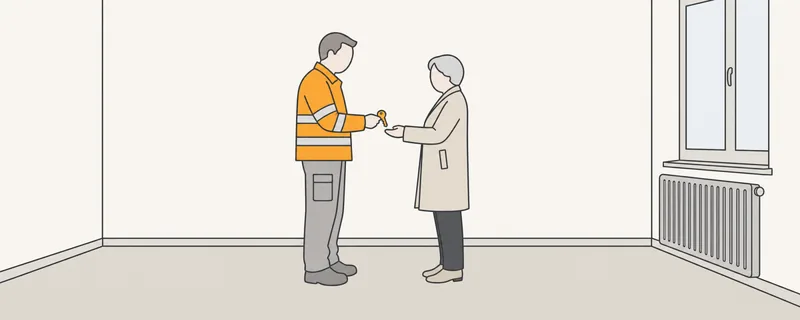
- Attend the handover. Anyone who sends the keys by post cannot object during the inspection.
- Read the full report. Sign disputed items only with the note “acknowledged”, without adding “accepted”.
- Record the final condition with dated photographs.
- Ask for the age and service life of every damaged item and have these recorded in the report.
If a claim arrives by letter only weeks later, check whether the defect is recorded in the report. If it is not, the claim is usually forfeited.
The deposit covers only documented damage
The rent deposit, called “security” in the law, is held in a blocked account in the tenant’s name (Art. 257e OR). It forms part of the estate. The bank releases it only if both parties consent or if there is a final order for payment or a judgment. If the landlord does not pursue a claim through legal proceedings within one year after the tenancy ends, the heirs may request repayment directly from the bank.
In practical terms, the property manager cannot retain the deposit for repainting without further steps. The claim must be supported by evidence, and the heirs must consent to the payment. Do not sign a release for items you do not owe under the service-life table. If there is disagreement, the conciliation authority for rental and lease matters is responsible. The procedure is generally without charge.
What “broom-clean” means
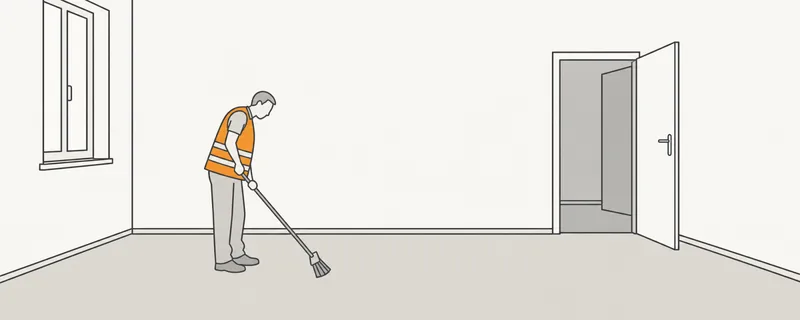
The term appears in many clearance quotations. It does not appear in the law. It means an empty flat without rubbish and with swept floors. This is not sufficient for returning the flat. Final cleaning is required: the oven and extractor must be degreased, windows cleaned inside and outside, sanitary fittings descaled, and the insides of cupboards wiped. Anyone who does not complete this cleaning must pay for replacement performance at the property manager’s rates. → Flat handover: What “broom-clean” really requires
Räumen & Werten hands over flats cleared and broom-clean. Final cleaning is listed separately in the fixed-price quotation. → Clearance and cleaning in Zurich
What heirs should do before the handover
- Find the tenancy agreement and the move-in inspection report. These show the condition in which the flat was taken over.
- Ask the property manager for the date of the last renovation.
- Take the service-life table to the handover.
- Complete minor maintenance beforehand or include it in the clearance quotation.
- Complete the clearance and final cleaning at least one week before the handover.
- Attend the handover and do not accept anything that is not supported by evidence.
Anyone who follows these points will pay what the law requires when returning the flat. Renovation for the next tenant remains the landlord’s responsibility.
This article provides general information on Swiss tenancy law and is not a substitute for legal advice in an individual case.
Common questions on this topic
Must heirs have the flat repainted after a death?
What counts as normal wear?
What is the jointly agreed service-life table?
Your question is not here? Call us: 076 606 22 83.