Every estate clearance turns up files, sometimes three, sometimes thirty. Relatives must decide which documents they need to keep and which they can dispose of.
There are two aspects to the answer. One is legal: you need certain documents because deadlines and proceedings are still ongoing. The other concerns data protection: anything you do not keep must be destroyed properly. An estate typically contains health data, financial data and third-party data.
Category 1: Secure immediately and keep indefinitely
These documents belong in a file that you take with you:
- Wills, marriage contracts and inheritance agreements. They must be submitted to the authority. Keep a copy.
- Certificate of inheritance (Erbbescheinigung), executor’s certificate (Willensvollstreckerzeugnis)
- Death certificate, with several originals
- Family register, civil status certificates
- Land Registry extracts, property purchase agreements
- Mortgage certificates (Schuldbriefe) and mortgage agreements
- Insurance policies that may give rise to claims: life, accident and pension provision
- Old-age and survivors’ insurance (AHV) certificate and contribution records, pension fund statements
- Securities inventories, custody account statements, savings books
- Contracts involving ongoing obligations: tenancy, leasing, loans and guarantees
- Declarations of guarantee, the most important category and the easiest to overlook
Check the files for guarantees and loan agreements before deciding whether to accept the inheritance. These are the most common source of debts that nobody knew about.
Category 2: Keep for a limited period
Keep tax records for 10 years: tax returns, assessment decisions and supporting documents. Additional tax proceedings may still be initiated years after the assessment. Without supporting documents, you cannot rebut a claim. Ten years from the end of the relevant tax period is a workable rule in practice.
Keep invoices and proof of payment for 5 years. Everyday claims, such as those for rent, building work, subscriptions or medical appointments, generally become time-barred after five years. You should be able to provide evidence of payment for that long.
Keep tradespeople’s records and construction documents relating to property for 10 years. Warranty periods for buildings run for up to ten years. You will need these documents if a defect emerges in an inherited property.
Keep evidence of value-enhancing investments until the property is sold. It can substantially reduce property gains tax (Grundstückgewinnsteuer). Even so, these documents are regularly discarded.
Keep documents from self-employment for 10 years: business accounts, accounting records and business correspondence. The retention obligation passes to the heirs.
Keep bank statements for 5 to 10 years, depending on whether they serve as tax evidence.
Employment references, diplomas and salary certificates are relevant when reconstructing AHV records. Keep them for as long as pension claims may remain outstanding.
Category 3: No longer needed, but still requiring destruction
Most paper records are no longer needed:
- Old advertising, brochures and catalogues
- Bank statements more than ten years old with no tax relevance
- Expired policies with no outstanding claims
- Instructions for appliances that are no longer present
- Old health insurance statements with no outstanding issues
- Correspondence with no legal significance
However, these documents contain personal data: account numbers, diagnoses, addresses, signatures and, in some cases, third-party data. The papers are not secure in household waste, and even less so in waste-paper bundles left by the roadside.
Destruction in line with data protection requirements
Since the revision of the Data Protection Act, stricter requirements have applied to the handling of personal data in Switzerland. The legal position is less stringent for private individuals acting within a family context than it is for businesses. However, health and financial data require particular protection even in private settings, and the practical standard should be the same.
There are three options:
-
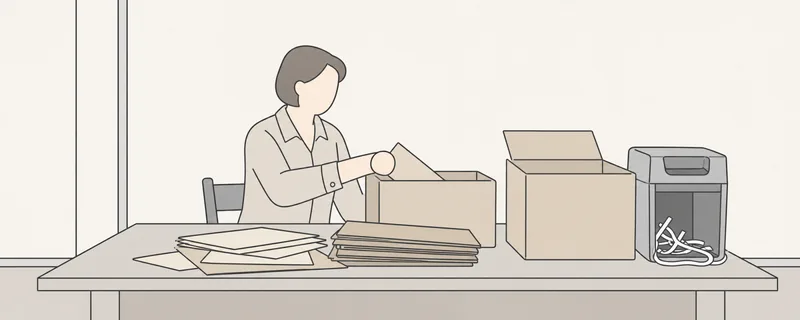
A cross-cut shredder, security level P-4 or higher. Strip-cut shredding is not sufficient because the strips of paper can be reassembled. This is manageable for one file, but hardly practical for thirty.
-
A waste disposal company that provides a certificate of destruction. This is suitable for larger quantities. The documents are placed in locked containers and destroyed industrially. You receive confirmation.
-
Through the clearance company. We agree the transport for document destruction in writing. Ask about it specifically. Not every company offers this service, and some simply dispose of paper as waste paper.
You must not put files containing bank documents out with waste paper or throw them into a skip without shredding them. Burning them in the garden is also prohibited and, in any event, unrealistic in residential areas.
Digital estates
In addition to paper documents, devices also hold data.
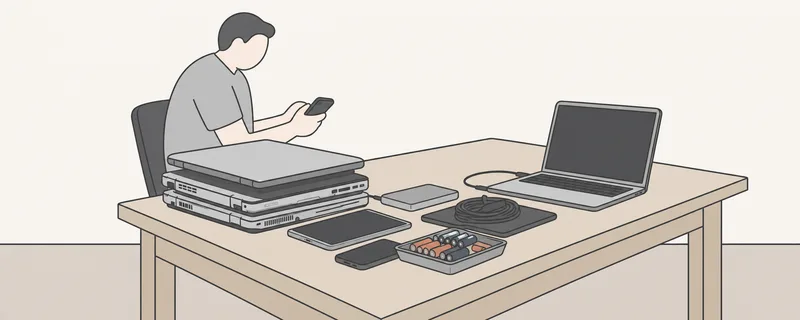
Computers, laptops, smartphones, tablets, external hard drives and USB drives often contain more sensitive data than any file. Before disposal:
- Back up the data the heirs wish to keep, especially photographs.
- Erase storage media or destroy them physically. Formatting is not sufficient. For HDDs, overwriting several times or physical destruction is effective. For SSDs, use the device’s own erase function or destroy the drive.
- Return the devices for recycling. In Switzerland, electrical devices are taken back free of charge through the advance recycling fee.
Close online accounts: email, social media, cloud storage, subscriptions and online shopping. Most providers have a procedure for deaths and require the death certificate and proof of entitlement as an heir. Allow for the work involved: closing the accounts takes longer than clearing the home.
Look for password lists, notebooks containing login details or a password manager. Without these, access to accounts is generally not possible. Some assets, such as crypto assets, are then effectively lost.
Practical steps during the clearance
-
Before the clearance, gather all files, boxes and loose papers in one room. Papers spread throughout the home can be overlooked during the clearance.
-
Sort them roughly into the three categories above. Allow half a day to a full day for an average household. It is quicker and less burdensome with two people.
-
Take categories 1 and 2 away in labelled boxes to a place where they can remain for ten years.
-
Arrange for category 3 to be destroyed, either as an item in the clearance quotation or separately.
-
Deal with photographs and personal documents separately. Photo albums, letters and diaries have no market value and are not subject to a retention obligation. However, they are the items relatives most often miss once they are gone. On request, we set aside any documents, letters and photographs we find and give them to you. Before the clearance, tell us which diaries or other items are personally important to you. We will look for them specifically and set them aside separately. We agree the scope and handover arrangements with you in advance.
Set aside time for this before the clearance. It cannot be done afterwards.
Common questions on this topic
How long must I keep a deceased person's tax records?
How should I destroy documents from an estate?
Your question is not here? Call us: 076 606 22 83.