Typical types of special waste found in a property are listed in Waste disposal in the Canton of Zurich. This article explains who may accept such waste, what applies to medicines and what to do if you suspect asbestos.
What counts as special waste
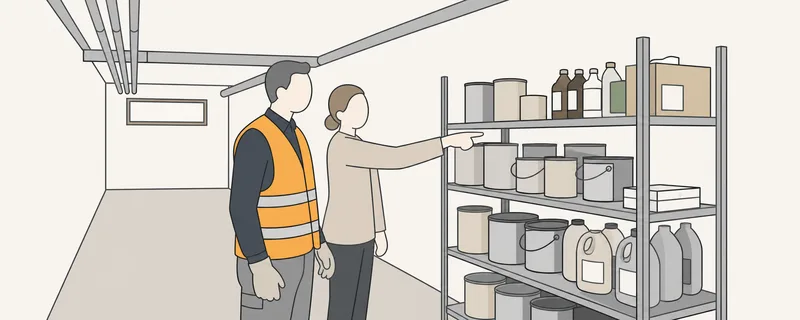
Special waste means waste designated as such in the list of waste under the Ordinance on Movements of Waste (VeVA) (Art. 3 VVEA). The City of Zurich gives household examples including paints and varnishes, solvents, aerosol cans, chemicals, acids and alkalis, cleaning products, batteries, gas cylinders, fire extinguishers and medicines.
Anyone handing over waste must first establish whether it is special waste (Art. 4 para. 1 VeVA). If in doubt, ask the collection point. Do not pour products from different containers together, as the Canton of Zurich warns that chemical reactions may occur.
Who may accept it
You may hand special waste only to collection points authorised to accept it (Art. 4 para. 2 VeVA). Waste disposal companies require a permit from the cantonal authority (Art. 8 para. 1 VeVA). According to the Federal Office for the Environment, the following may accept household special waste:
- authorised waste disposal companies, such as municipal collection points
- collection points designated by the authorities, for example for engine oil, cooking oil, fluorescent lamps or household batteries
- retailers, provided they sold the product at retail, such as specialist shops or pharmacies
The cantons arrange the separate collection of special waste from households (Art. 13 para. 2 of the Ordinance on the Avoidance and Disposal of Waste, VVEA). There are three options in the Canton of Zurich: retailers, the mobile special waste service and the cantonal Hagenholz collection point. Small quantities may be handed in free of charge at the mobile service and at Hagenholz up to a limit per person per year, while larger quantities incur a charge at Hagenholz. The limit may be exceeded during a property clearance. The canton publishes the current limit on zh.ch. In other cantons and municipalities, check the available local services.
Medicines
The City of Zurich classifies medicines as special waste and asks you to bring the complete packaging without unpacking anything. The Canton of Zurich states that retailers accept medicines, in some cases for a charge, and that the mobile special waste service also collects them. Ask the pharmacy in advance whether it charges a fee.
Suspected asbestos
This article does not explain how to remove asbestos. That work is for recognised specialist companies.
The Federal Office of Public Health (FOPH) gives the following rule of thumb: various materials containing asbestos should be expected in buildings constructed before 1990. A broad ban on asbestos has applied in Switzerland since 1989. Examples given by the FOPH include sprayed asbestos, asbestos board behind radiators or beneath window sills, and lightweight boards containing asbestos on doors. Fibre-cement products are usually unproblematic if left intact.
The risk arises when the material is worked on: sanding, drilling, sawing or breaking it can release large quantities of asbestos. If there is a specific suspicion, a material analysis by a specialised laboratory is usually required. Suva states that remediation involving substantial fibre release may be carried out only by companies recognised by Suva. The remediation work must be reported at least 14 days before it begins.
The waste ordinance lists waste containing asbestos under its own waste code (Annex 1, code 4105). If it arises during construction work, the client must provide the building authority with information about its disposal where asbestos is to be expected (Art. 16 para. 1 VVEA).
For a clearance, this means that we stop work if we suspect asbestos and investigate. Only in such cases might one of our appointments be cancelled. In a rented property, inform the property management.
For an overview of how disposal works during a clearance: → Property clearance: What happens to the belongings?
Common questions on this topic
May I put leftover paint and chemicals in household rubbish?
What should I do if I suspect asbestos in an estate property?
Your question is not here? Call us: 076 606 22 83.
Sources and date (8)
- VeVA, Ordinance on Movements of Waste (SR 814.610), version as at 1 August 2025, Art. 4 paras. 1 and 2 (obligations of holders), Art. 8 para. 1 (permit requirement) Statute, court or authority · retrieved 15 October 2026
- VVEA, Ordinance on the Avoidance and Disposal of Waste (SR 814.600), version as at 1 August 2026, Art. 3 letter c (special waste), Art. 13 paras. 2 and 3 (cantons), Art. 16 para. 1 letter b (asbestos during construction work), Annex 1 (code 4105) Statute, court or authority · retrieved 15 October 2026
- FOEN: Obligations of households (2019 page), Who may accept special waste from households; no proof of handover is required Statute, court or authority · retrieved 15 October 2026
- Canton of Zurich: Special waste, Disposal routes, quantity limits, medicines, information on household rubbish and the sewer system Statute, court or authority · retrieved 15 October 2026
- Canton of Zurich: Household waste, Advice not to mix products from different containers Statute, court or authority · retrieved 15 October 2026
- City of Zurich: Special waste, Examples (paints, medicines, batteries), disposal routes Statute, court or authority · retrieved 15 October 2026
- Federal Office of Public Health: Asbestos, Sections on occurrence, risks and what to do if asbestos is suspected; the page gives no date Statute, court or authority · retrieved 15 October 2026
- Suva: Asbestos removal companies, Remediation involving substantial fibre release only by companies recognised by Suva; notification 14 days before work begins Statute, court or authority · retrieved 15 October 2026
Last reviewed 15 October 2026.